
Start a Sandwich Residents Search
Pick the record that matches the question. An owner name or a street address belongs first with Sandwich Assessing and MapGeo. A recorded transfer belongs with the Barnstable County Registry of Deeds. A person who appears in an old household needs a dated directory, newspaper, census image, or family-file lead. These are separate sources, and a match in one does not turn into a full biography.
For current facts, begin with a lawful public record and record its date. For a past household, start with the year and the address form used at that time. Sandwich has village names, postal labels, parcel addresses, and historic road names. Keeping those labels separate makes a residents-directory search much more reliable.
- Use an address in the Sandwich parcel resources to identify the parcel and owner displayed there.
- Search the owner name in the Registry index, checking grantor and grantee sides and spelling variants.
- For a known individual, use the Massachusetts voter-status tool only for its limited individual result.
- Move to a dated directory, newspaper, or archive collection when the goal is historical.
- Ask the proper custodian for a narrow record series when no published index supplies it.
Note: A parcel owner, mailing recipient, court party, and directory entry can each be a different connection to Sandwich.
Sandwich Offices for Resident Records
Sandwich is a town, so the local path begins with Town departments rather than a city-wide people index. The Town Clerk keeps vital, election, and public-record functions. Assessing and Engineering/GIS maintain parcel-facing resources. Barnstable County holds the deed system, while Massachusetts runs court and voter portals. The address-by-address sequence is detailed in the Sandwich street directory.
Each office answers a different question. A Registry instrument can establish that a party signed a recorded document. A parcel card can show the owner and address fields presented by the assessor. Neither confirms every person in a home. For certified copies, correction requests, and records that are not available online, contact the office that owns the record.
Barnstable Registry of Deeds
3195 Main Street
Barnstable, MA 02630
508-362-7733, option 8
MapGeo Leads to Sandwich Deeds
Sandwich MapGeo is the practical first stop for a parcel lead. Select the parcel, note the public owner and parcel context if displayed, then take the owner name to the Registry. Town GIS data and visible map layers are not guaranteed to be current, and the public text inspection did not confirm every live control or field label. Treat the map as a research lead, not a survey or proof of occupancy.
The Registry’s strongest route is the name index. Its address search is only a secondary lead: it began in August 1993 and the Registry calls it unofficial and incomplete. Search the owner as a grantor and a grantee, then read the recording date, document type, book and page or instrument number, town, and image availability. That chain is often more useful than a street search alone.
| Registry name-search field | Use in a Sandwich property trail |
|---|---|
| Last name or corporation | Required search key for a party or entity. |
| First name | Optional way to narrow a surname result. |
| Party side | Choose all parties, grantors, or grantees. |
| Document type and town | Limit a result to the relevant instrument and Sandwich. |
| Year or date range | Use all years, index choices, or a specific range. |
The Registry public-access page explains that online views are research copies. A browser image is not a certified copy.
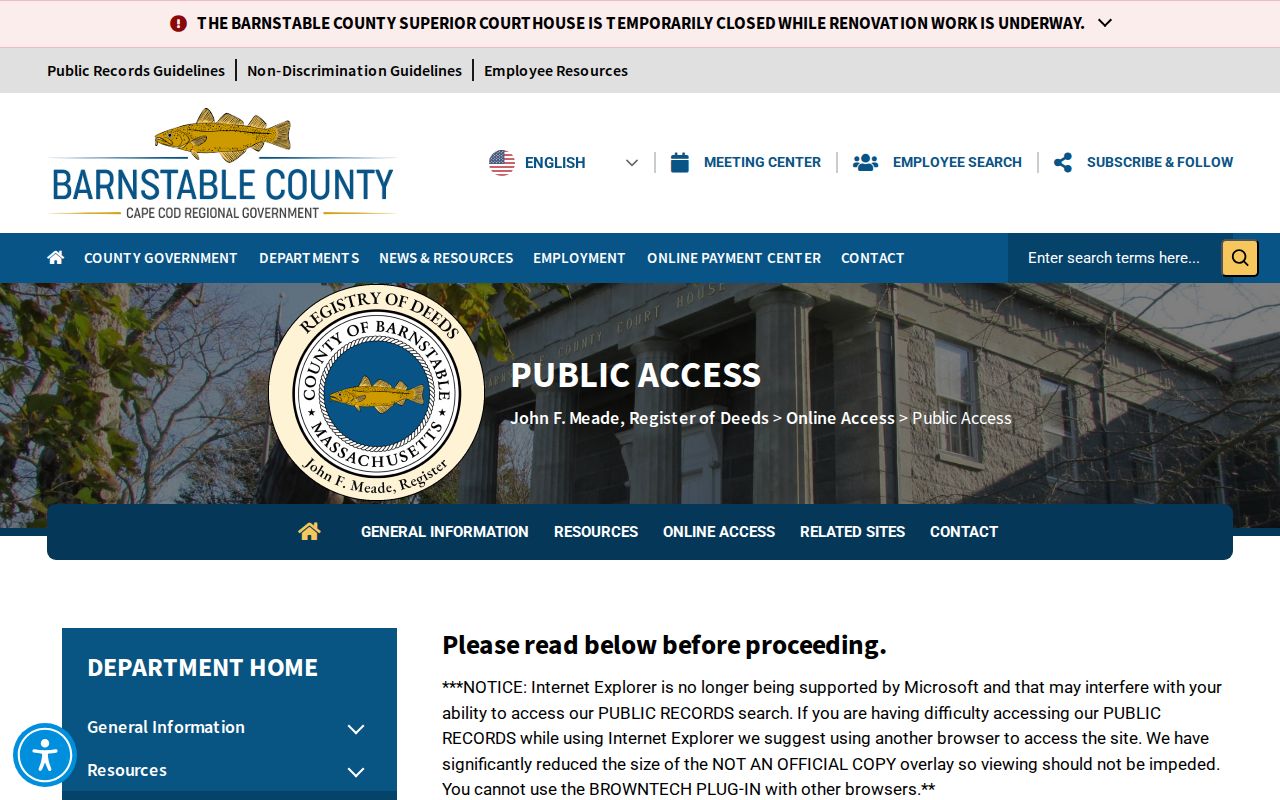
The Registry image illustrates the public research route, which still needs a formal copy process when an official copy is required.
Sandwich Voter Status Boundaries
The Massachusetts voter registration search is an individual status check, not a browseable Sandwich roster. It asks for first name, last name, date of birth, a five-digit residential ZIP, and an agreement checkbox. Its permitted result can report registered or pre-registered status, active or inactive status, a polling location, and certain elected officials.
That result does not establish current physical presence, ownership, citizenship, or a complete household. Sandwich lists a voter or resident list by CD or email for $15 and an annual street list for $20, but the research did not verify the current order form, fields, redactions, delivery method, or use limits. Ask the Town Clerk what can lawfully be provided before requesting a dated list.
| Portal field | Role |
|---|---|
| First and last name | Supplied match components. |
| Date of birth | Match key entered by the requester. |
| Residential ZIP | Match and polling-geography input. |
| Agreement | Required acknowledgement before search. |
| Result | Limited registration-status information, not a profile. |
The voter-status page shows the controlled, individual form instead of a searchable townwide list.
Its required match details make clear why a result has to be read as a limited status response.
Current Sandwich Resident Records
There is no single official current directory of everyone in Sandwich. The available public paths are purpose-built. They can show an ownership connection, a limited voter-status result, a recorded party, a court party subject to access rules, or a local business or license affiliation. Compare the source date and the type of address shown before treating two results as the same person.
| Sandwich record source | Connection it can show | Custodian | Access route |
|---|---|---|---|
| Assessment or parcel card | Owner of record, situs or mailing fields where public | Sandwich Assessing | MapGeo and field-card links |
| Voter status | One person’s limited registration status | Commonwealth elections system | Name, DOB, and ZIP query |
| Recorded deed or plan | Grantor, grantee, and title chronology | Barnstable Registry | Free online index and images |
| Court docket | Party, case, events, and disposition | Trial Court or clerk | Portal subject to court rules |
| Town street or resident list | Dated municipal list where available | Sandwich Town Clerk | Confirm format and redaction first |
Commercial compiled-search products can seem convenient, but they may mix stale, uncertain, or conflated entries. Official custodians and cited archives give a reader a clearer record type, date, and correction route. A narrow request may be useful when an index is absent, but it cannot override a sealed, restricted, or protected record.
Sandwich Court Docket Limits
Massachusetts Trial Court eAccess separates a court department, division, location, and result count from the search tab. It offers Name, Case Type, Case Number, and Ticket or Citation routes. Civil name searching requires a last name and first name, while a known case number depends on exact capitalization, spaces, and leading zeros. A case-type search uses a maximum 30-day window.
A docket can supply a party name, docket number, case type, filing and event dates, and a status or disposition. It is not automatically the complete file. Juvenile, sealed, impounded, adoption, abuse-prevention, and other protected matters have limits. Barnstable Probate and Family cases also follow their own access boundary. Ask the clerk for copies or a public-terminal route when the portal does not expose an item.
The Trial Court entry page provides the official search start for a Sandwich-related docket.
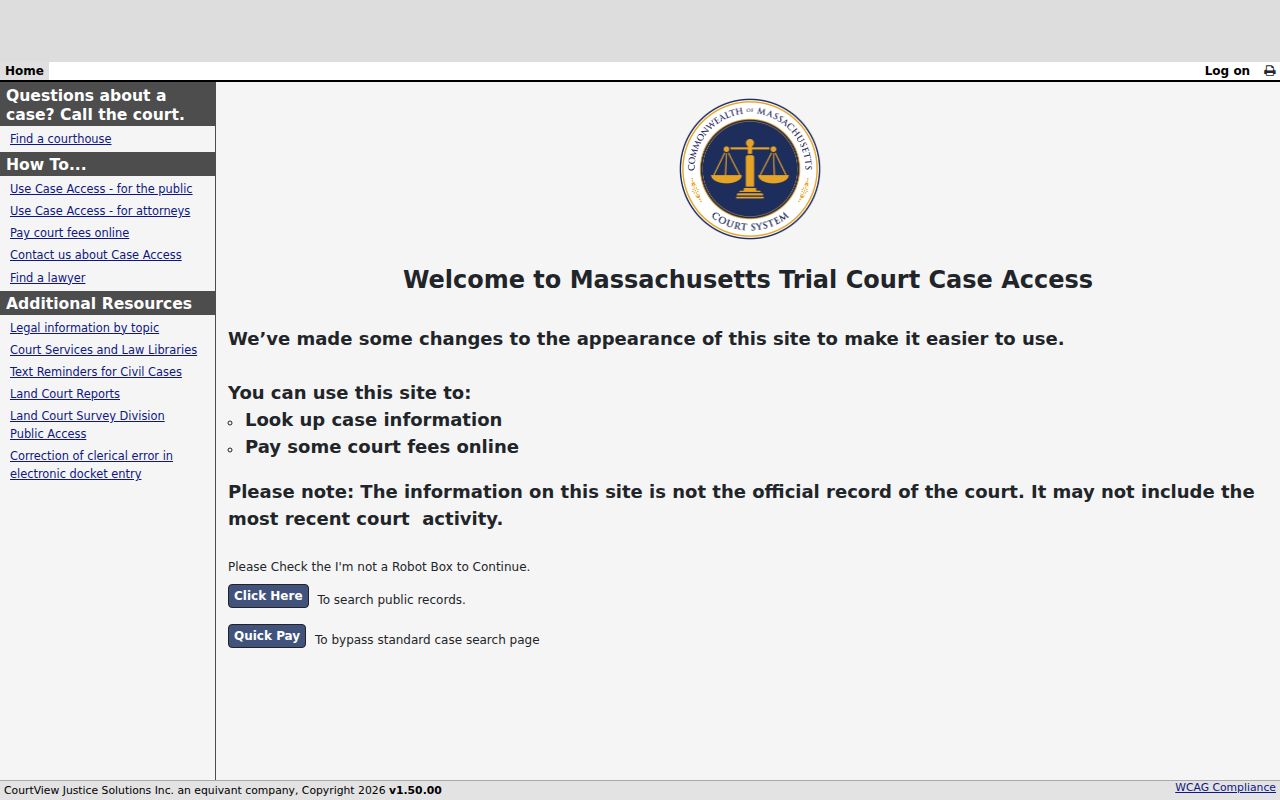
The portal image is an entry point, not evidence that every court document or case category is open online.
Sandwich Vital Records by Year
Vital records take three different paths. The Sandwich Town Clerk lists local certified birth, marriage, and death copies at $10 each. The Commonwealth’s RVRS route holds records from 1936 forward. The Massachusetts Archives handles 1841–1935 material, including free digital copies for 1841–1930 through FamilySearch and a separate copy process.
Year and event place decide where to ask. A birth connected to unmarried parents, an adoption-related original, related marriage records, and full Social Security numbers on death records can be restricted. The research did not support a single universal closure period. Keep the record’s source, year, and access rule together rather than guessing from an online index.
The Massachusetts vital-order route distinguishes state ordering from the local Clerk and Archives channels.
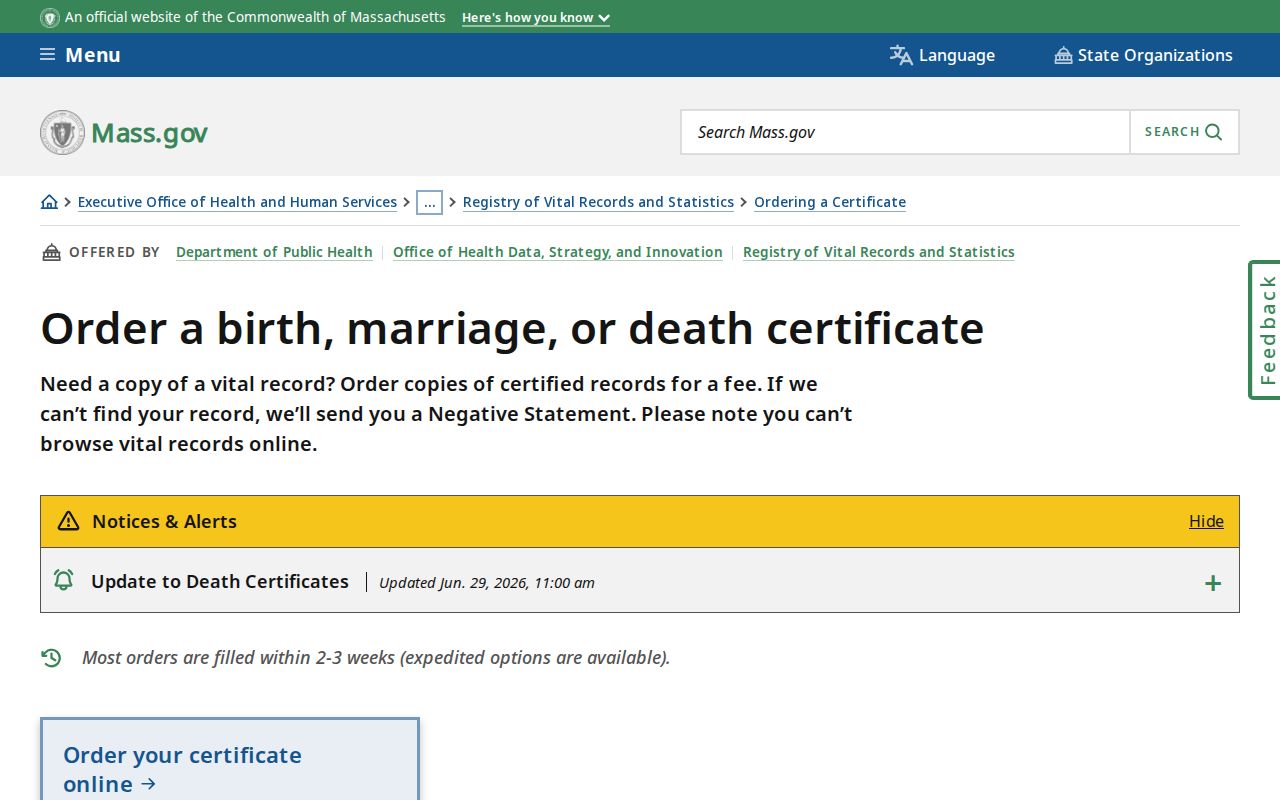
The state order page is one part of a time-based vital-record path, not a general name-search directory.
Sandwich Records Requests
Some useful town records have no public search screen. The Sandwich Records Access Officer is Town Clerk Taylor D. White. Requests may go by email at twhite@sandwichmass.org, mail, or in person at 100 Route 6A. The Town prefers email and its published process calls for acknowledgement within 24 hours or less and a response target of 10 business days.
Under the Massachusetts Public Records Law, M.G.L. c.66 §10 and 950 CMR 32.00, identify the custodian, record series, date range, preferred format, and safe response method. The Town may produce a record, redact it, cite an exemption, refer the request, estimate fees, or ask for a narrower request. Published fees include five cents per black-and-white page and possible staff time after the first two hours, with an itemized estimate before charges.
- Name the department and the specific record series, such as approved minutes or permit inspection results.
- Give a date range and location or permit number when it is relevant.
- Ask for the available public version and a fee estimate before work begins.
- Keep the response date, any redaction explanation, and the office named in the reply.
Sandwich Resident Directories from History
A directory is a dated editorial snapshot, not a current list. The State Library holdings identify Sandwich directories for 1900, 1908, and 1926, with voting lists for 1924, 1978, 1980, and 1988. National Archives regional holdings add Sandwich years 1903, 1908, 1926, and 1929. The actual volume may organize entries by name, business, street, or another system, so confirm the volume before expecting a reverse section.
Sandwich Public Library Archives, the Historical Society, the State Library, and regional repositories make up the historical shelf. A full year-by-year approach, including a reading checklist and archive access details, is on the Sandwich city directory collections page. Capture the volume title, year, page, spelling, and any street or household notation before linking two names.
Sandwich Directory Years and Archives
Sandwich Public Library Archives brings together family files, local newspapers, property asset files, yearbooks, maps, town reports, meeting records, and historic photographs. An appointment is recommended because rare local-history material is non-circulating and the Reading Room has handling rules. The library also offers Ancestry Library Edition on site.
These collections work best when a researcher asks a precise question: whether a surname file is arranged by family or property, which years are indexed, and whether an OCR search has missing issues. A family file is a finding aid, not proof of identity. A newspaper or directory reference gains strength when it is paired with an independent deed, census image, vital record, or archive citation.
The Archives collection page describes the local materials and its access conditions.
Sandwich's 1858 Village Directory
Sandwich’s historic map shelf has an unusually useful bridge between people and place. The Historical Commission’s historic maps collection identifies the 1858 Walling map of Sandwich Village and an accompanying business directory. It can connect a business name or village label to the way a place was described at that date.
Use that bridge carefully. Preserve the map year and historic road label, then compare them with later newspapers, deed index entries, or directories. Route 6A also appears as Old King’s Highway in historic context. Research did not verify a complete former-name or renumbering crosswalk, so an apparent mismatch belongs with Engineering, Assessing, the Archives, or the Registry, not a guessed conversion.
Sandwich Newspapers Since 1846
The Sandwich digital newspaper archive has local titles beginning in 1846. Its listed local runs exceed 100,000 digitized pages. Search a surname with a village, business name, event, or year window, then inspect nearby pages because OCR can miss names. Record the title, issue date, page, image URL, and wording around the result.
A notice can show that a name appeared in a dated local context. It does not prove a current address or merge two people with the same surname. The 1846 start, the 1858 map directory, nineteenth-century deeds, and later directory runs give Sandwich a layered historical trail that a single search field cannot reproduce.
Note: Local page totals measure the archive collection, not the number of unique residents or families in Sandwich.
Sandwich Courthouse Access in 2026
Barnstable County’s July 2026 notice reports that Superior Courthouse construction has begun, the courthouse is closed, and reopening is expected in summer 2027. Superior Court operations moved to the First District Courthouse, while county public-facing offices were scheduled for the lower level of the Registry and Probate building.
The legal custodian and online portal remain the starting points, but an in-person plan may change during the work. Confirm the current court or Registry instructions before travel. Keep the access date with any research note so a closed counter, a portal interruption, and a legally restricted record are not confused.
The county construction update shows the temporary access information that affects a Sandwich court-record visit.
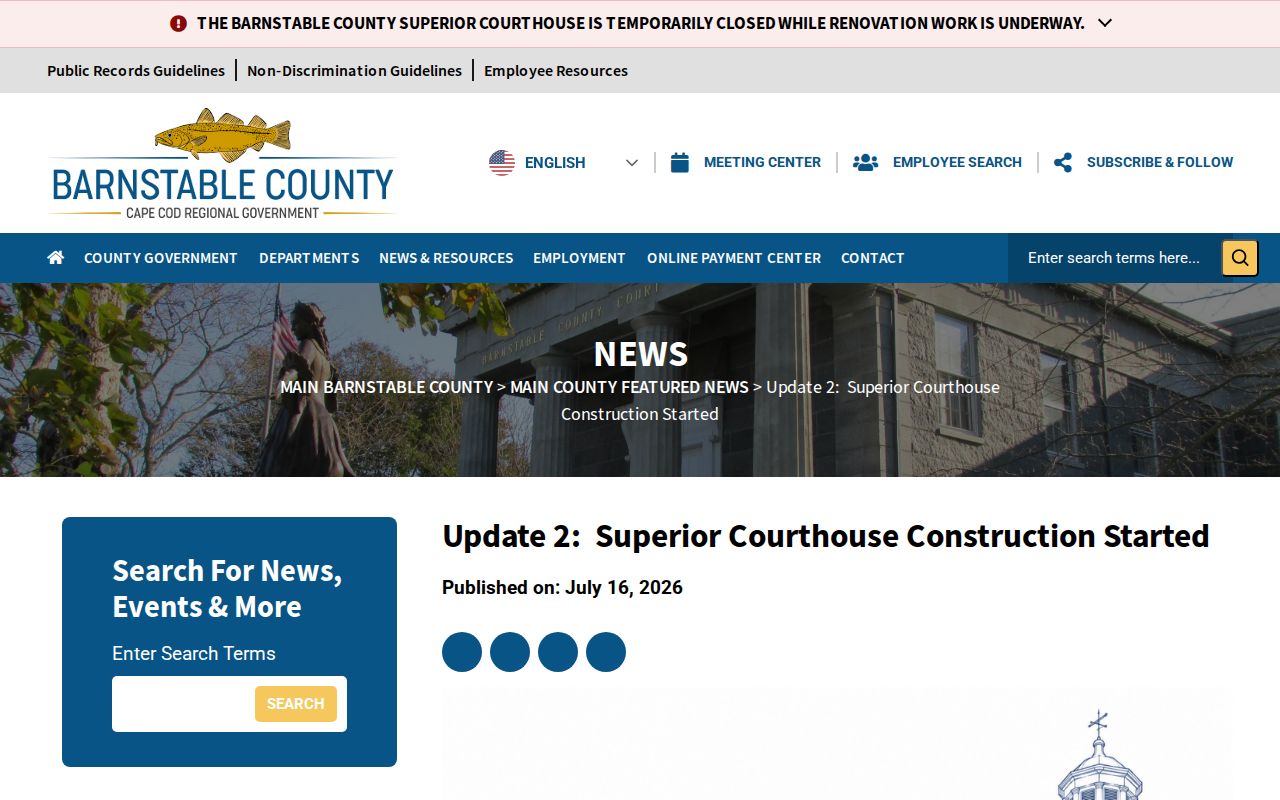
The notice is a useful reminder that a record’s custodian, access point, and physical location can change independently.
Sandwich Records Stay Limited
Public access has boundaries. Massachusetts address-confidentiality rules can substitute or protect an eligible person’s address. Court files can be sealed or impounded. Vital records have record-specific access rules. Driver data is limited by the federal Driver’s Privacy Protection Act. The fact that an index returns a name does not authorize copying every field into a new list.
Use the custodian’s correction, redaction, or access process for a sensitive record. Keep source dates and distinguish an assessor situs address, a mailing address, a business address, and a historic address. That disciplined approach protects people and makes a Sandwich result easier to verify later.
- Parcel
- A mapped unit of land used in assessment and property records.
- Index
- A finding system that points to a record; it may not include the whole record.
- Situs address
- The physical location of a parcel, which can differ from a mailing address.
- Criss-cross directory
- A directory arranged by address or street when a particular volume actually includes that section.