
Sandwich Previous Residents by Era
A backward address trail has several layers. Begin with the current parcel and latest recorded transfer, then move to household sources when the question is who lived there rather than who held title. Coverage is uneven. The table separates official ownership records, dated local sources, and federal household snapshots so a blank result in one source is not treated as proof that no person was connected with the address.
| Source | Years it covers | Where held | What it shows |
|---|---|---|---|
| Registry land records | 1742-present, with old-image exceptions | Barnstable County Registry of Deeds | Recorded transfers, plans, liens, and legal descriptions |
| Land Court | 1898-present system coverage | Registry and Land Court route | Registered title records |
| Sandwich and regional directories | 1900, 1908, 1926; 1903, 1908, 1926, 1929 | State Library and NARA holdings | Dated name and address leads |
| Local newspapers | 1846-2026 | Sandwich digital archive and library | Moves, deaths, businesses, and community notices |
| Federal census | Released federal years under the 72-year rule | NARA and library research routes | Historical household snapshot |
Use the deed series for a transfer question and directories or census material for a household question. A parcel owner can be an estate, trust, company, or person who did not live at the site. Newspaper items and family material may explain a change, but they should be cited for the fact they actually state.
Sandwich Parcel Records Start
Start with Sandwich Assessing and the public Sandwich MapGeo viewer. Use the address or parcel map to identify the assessed owner, parcel or map-lot reference, and any public card details. The research did not establish the exact live MapGeo field labels, so verify the displayed fields and retrieval date when researching a particular property. The town also disclaims currentness and warranty for GIS data.
Keep the situs address separate from a mailing address. The situs is the parcel's location; the mailing address is where a tax bill or notice is sent. Either can be a useful research lead, but neither establishes who was living at the address. The owner name is the bridge to the Registry's name-based index.
Note: Copy the owner spelling and parcel reference exactly before searching deeds, because initials, corporations, trusts, and punctuation can change the result set.
Sandwich Registry Records Leads
The Registry's address search is useful as a lead, not as the final deed search. Its address indexing begins in August 1993, and the Registry describes it as unofficial and incomplete. Try reasonable street-suffix variants if a search fails, then convert any lead to an owner-name search. A blank address result does not prove that no deed, plan, or transfer record exists for the property.
The Barnstable Registry address-search page shows the secondary address route.
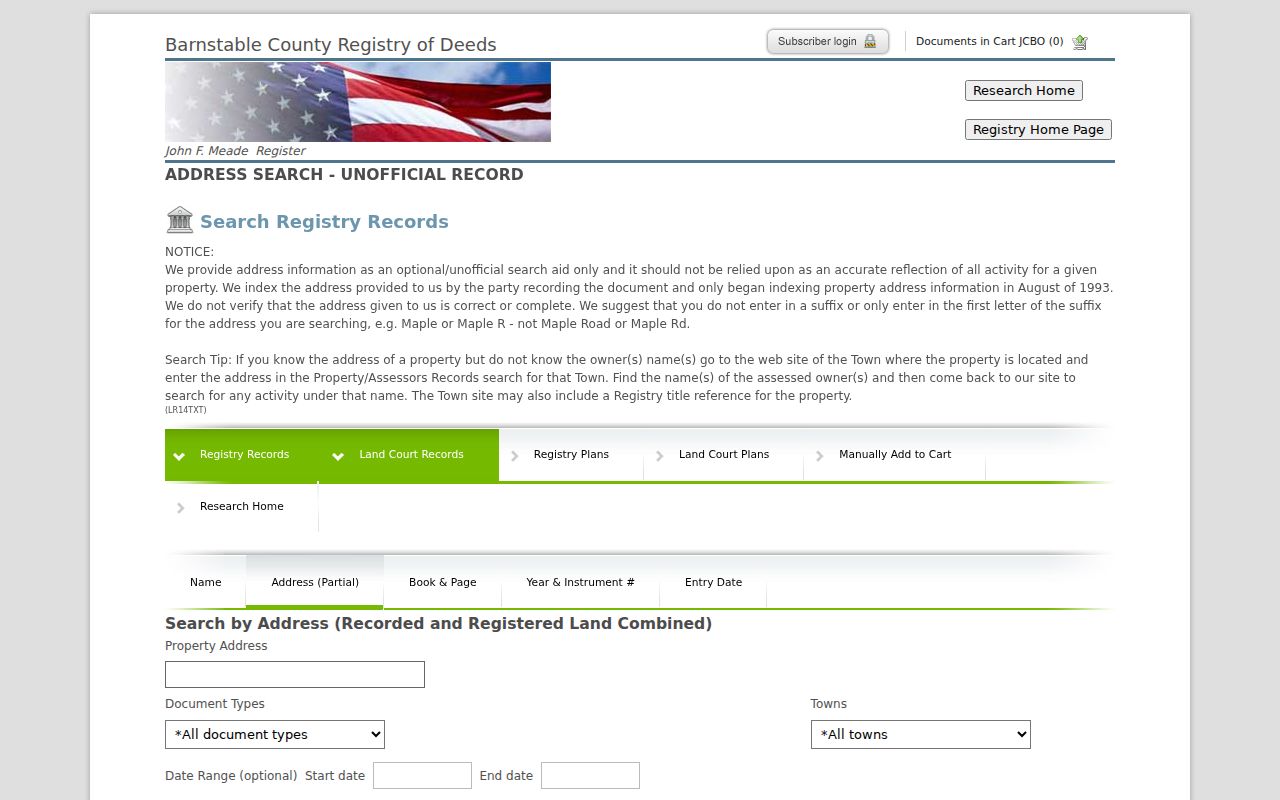
Use the address screen to locate a possible document, then record its parties, town, document type, recording date, and book-page or instrument number before testing the deed chain by name.
Sandwich Deed Records History
The backward ownership method starts with a current assessed owner, then works through the recorded transfer that brought that owner into the chain. The Registry's name search requires a last name or corporation and offers first name, grantor or grantee side, document type, town, and date controls. Search the owner in both party roles, include Sandwich as the town where appropriate, and preserve a result's legal description and plan references for the next step.
- Use Assessing or MapGeo to record the current owner, parcel reference, and property address as displayed.
- Find the latest related deed in the Registry name search, noting the seller, buyer, date, document type, and book-page or instrument number.
- Search the seller as a prior buyer or grantee to locate the earlier acquisition, then read the linked record.
- Repeat the seller-to-prior-transfer sequence while checking legal descriptions, plan citations, town, and spelling variants.
- Stop and document a branch when the record points to probate, a trust, a corporation, Land Court, or a missing or oversized image.
- Grantor
- The party transferring an interest in a recorded deed or other instrument.
- Grantee
- The party receiving that interest. In a backward search, the earlier seller can lead to the prior purchase.
- Chain of title
- The documented sequence of transfers and related instruments affecting a parcel. It is not a list of everyone who lived there.
- Legal description
- The deed's formal parcel description, often using bounds, lot, plan, or other recorded references. It is more durable than a changing street label.
Sandwich Deed-Chain Branches
Some transfers do not look like an ordinary sale. If title passes through an estate, consult the relevant Probate and Family Court docket and estate filings. A death certificate recorded to update title or assessment information is not itself a deed transfer. Trusts, corporate entities, and registered Land Court property each require their own party-name or record route. Do not skip a difficult link merely because the same address appears again.
Online Registry indexes and document images are free to view, but a browser image carries a nonofficial-copy overlay. The Registry reports that nearly all records are online while some very old materials and oversized plans need an office or archive route. The Registry research desk is at 3195 Main Street/Route 6A, Barnstable, Monday through Friday, 8:00 a.m. to 4:00 p.m., with mail and copy procedures available when an online image is not enough.
The Registry's public-access guidance explains the free research access and nonofficial nature of online images. Use the Registry copy process for a certified or legal copy rather than treating a browser PDF as certified evidence.
For a deed-copy request by mail, the Registry asks for $3 and a self-addressed stamped envelope, along with a book and page or document number when known. Its guidance also permits an owner name plus street and town as a starting description. This is a copy route, not a Registry title search or legal advice. Record the source date because the fee and procedure should be checked before ordering.
Sandwich House History Records
The Historical Commission's house-history guidance separates questions that are often blended together. It directs researchers to the Historic Asset List or MHC Form B, the Archives Room, the earliest recorded deed, tax and newspaper evidence, Sturgis Library, and the Registry. A property's year built, earliest recorded owner, alternate name, and historical significance are separate findings. Mark each conclusion with the source that supports it.
The Sandwich Historical Commission house-history guidance sets out those local research leads.
The guide helps organize evidence around an address without assuming that a deed date, tax detail, or newspaper mention answers every house-history question.
Building permits can date a project, inspection, or amendment, but they do not establish a complete household history. Sandwich links Permit Eyes for permit applications and status, with its current online era launched in 2020. For older construction questions, combine any permit lead with archival, tax, deed, and newspaper evidence rather than treating a permit date as the construction date.
Lawful use. Research an address for family history, estate work, local history, or personal curiosity. Do not use a record trail to pursue, harass, or endanger a living person.
Sandwich Previous Residents Household Trail
Ownership is only one layer of an address history. State Library holdings identify Sandwich directories for 1900, 1908, and 1926, while NARA's regional volumes include Sandwich for 1903, 1908, 1926, and 1929. Pair an available directory entry with a released federal census year to test a household at a particular moment. Keep the census year, enumeration geography, spelling, and whether the result was an index or image.
- Start with a cited directory year and capture the name, address wording, volume title, and page.
- Find the nearest released census snapshot and compare household names, locality, and spelling without forcing a match.
- Search local newspapers for a move, death, business, school, or community notice that explains a change between snapshots.
- Use deeds and probate to separate the property owner from occupants, heirs, or other associated people.
For collection details and a careful directory-entry capture method, use the Sandwich city directory collections. The absence of a verified criss-cross section means address-order lookup should be confirmed in each actual volume rather than assumed.
Note: Directory, census, and newspaper evidence can support a dated household connection, but each source has different omissions and naming conventions.
Sandwich Route 6A Address Labels
Historic Sandwich research often encounters Route 6A and Old King's Highway as road labels. Preserve the wording from the old map, directory, deed, or newspaper beside the current parcel reference. No verified universal former-name or renumbering crosswalk was located. A historic label is a research clue, not permission to convert it automatically into a modern mailing address.
The Historical Commission's historic maps include the 1794, 1857, 1858, 1880, and 1884 map leads. Compare the map year and locality with deeds and assessor material, and ask Engineering, Assessing, Archives, or the Registry when the trail seems to jump.
Sandwich Previous Residents Over Centuries
Bare address searching can hide the depth of a Sandwich record trail. Barnstable County land records begin in 1742, local digitized newspaper leads begin in 1846, the 1858 Sandwich Village map includes a business directory, and the known directory volumes add early twentieth-century snapshots. These sources can describe the same place at different times, but they do not share a single identifier or a uniform level of detail.
The most reliable sequence is MapGeo or an assessed field card to an owner name, then Registry name searching, followed by plan or book-page review. From there, test dated household sources and archival context. That method gives an address lead a documented trail while leaving unresolved names or gaps clearly unresolved.