
Sandwich City Directory Holdings
Sandwich has a small, clearly identified set of historical directory leads rather than one continuous local run. The State Library lists Sandwich directory holdings for 1900, 1908, and 1926. NARA's regional directory holdings add volumes that include Sandwich for 1903, 1908, 1926, and 1929. Those lists establish what years deserve a request or a shelf check. They do not establish a complete publication history, a publisher, or that every household was listed.
| Collection | Years | Where held | Access |
|---|---|---|---|
| State Library Sandwich directory holdings | 1900, 1908, 1926 | State Library of Massachusetts | Holding list and special-collections contact route |
| NARA regional volumes that include Sandwich | 1903, 1908, 1926, 1929 | NARA city-directory holdings | Holdings guide identifies regional coverage |
| Sandwich Archives companion material | Yearbooks from 1964; senior photos 1940-1974 | Sandwich Public Library Archives | Appointment recommended |
| Digitized local newspapers | From 1846 | Sandwich digital newspaper archive | Online search, with dynamic query controls |
Begin with the dated holding that fits the question. A directory can place a person, household, or business in a given year; it cannot by itself prove identity, ownership, or continuous residence. The absence of a name can reflect an incomplete volume, a different spelling, a regional title, or an unlisted person. Record the repository, year, volume title, and page before moving to another source.
Note: The reviewed holdings identify years, not publishers, a first printed year, a final printed year, or a verified criss-cross section.
Sandwich Archives Research Visit
The Sandwich Public Library Archives is the useful local stop when a directory lead needs context. It keeps family files, property files, maps, yearbooks, historic photographs, and newspapers, alongside local biographical and town-history material. Rare or out-of-print local-history materials are non-circulating and handled in a controlled Reading Room. An appointment is recommended, so ask the archivist whether the specific volume, family file, map, or yearbook can be consulted before making a trip.
The library is at 142 Main Street, Sandwich, MA 02563, and its listed phone number is 508-888-0625. Listed public hours are Tuesday through Thursday, 9:30 a.m. to 8:30 p.m., and Friday through Saturday, 9:30 a.m. to 4:00 p.m. Confirm hours and Archives access before visiting. The Archives also lists newspapers back to 1846, annual town reports and meeting records, and property material that can test a directory-based conclusion.
The Sandwich Public Library Archives page describes the collection and its access conditions.
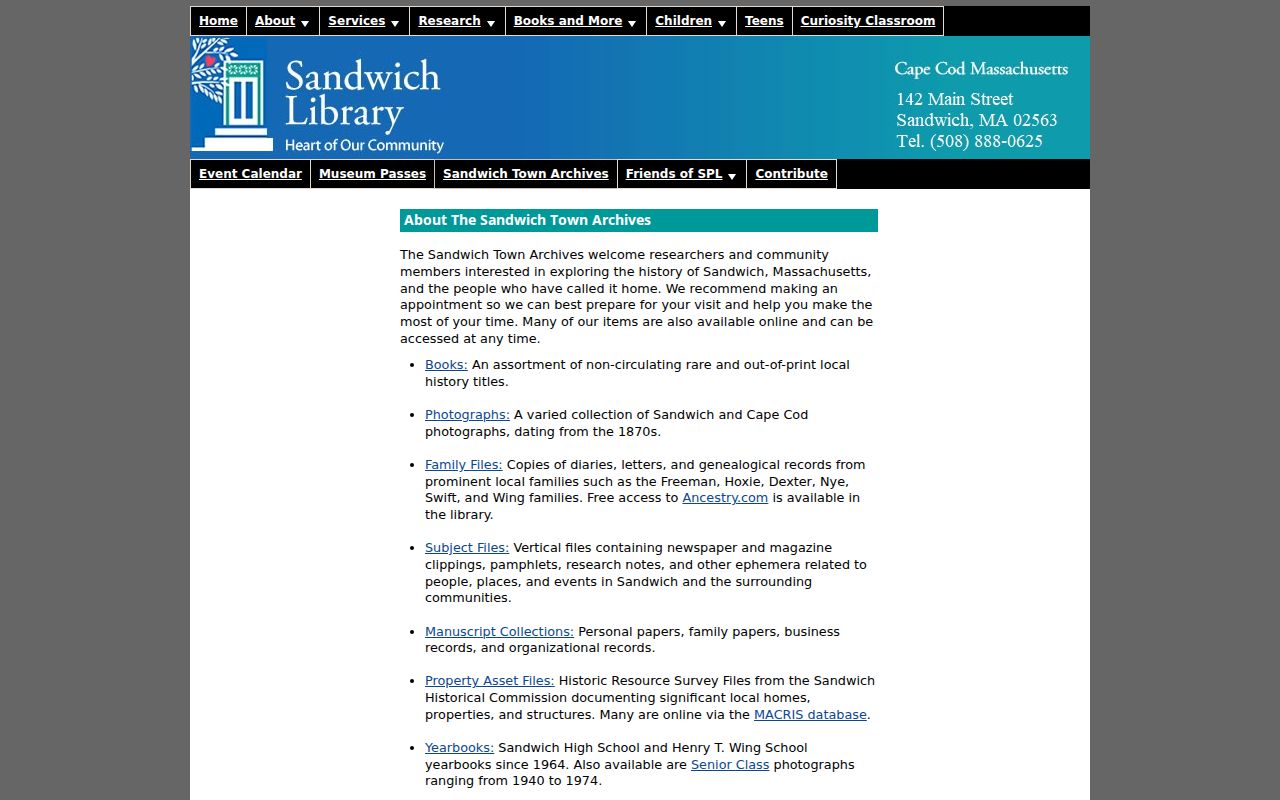
The Archives screen is a reminder to plan for collection-level research, not a claim that an online image supplies every historical directory entry.
Sandwich Directory Holding Years
The State Library holdings list is the best starting record for the three explicitly named Sandwich years. It also lists local voting lists for 1924, 1978, 1980, and 1988. A voting list is a separate record type, so use its date and access conditions on their own terms rather than treating it as another city directory.
The NARA city-directory holdings point to regional volumes containing Sandwich. Compare their title wording and coverage to the State Library list before assuming two citations describe the same book. The actual volume title page and page citation matter. Neither holding list supplies an unrestricted sampled Sandwich entry, so avoid filling missing details with standard directory conventions.
State Library special collections offer a contact route, with appointments recommended. At the local Archives, Ancestry Library Edition is free for use in the library and can help test a census lead beside a directory citation. Ask for the record series, year, and access conditions instead of assuming a holding-list entry is digitized or available without advance coordination.
Reading Sandwich Directory Evidence
No unrestricted Sandwich sample entry was examined in the reviewed material. Treat the following as a capture checklist for a volume that is actually open, not as a description of symbols or fields proven to appear in every Sandwich city directory. Photograph or transcribe the title page and abbreviation page first, then keep the exact page citation with the name.
| Name as printed | Capture spelling, initials, suffixes, and any nearby household wording exactly. |
|---|---|
| Address or locality | Capture the street, number, village, or other location wording only if printed in the volume. |
| Occupation or business | Record it as a dated activity lead, not proof of a continuing role. |
| Household notation | Copy any relationship, spouse, boarder, owner, or renter notation only when the volume defines it. |
| Volume citation | Keep title, year, page, repository, and image or photocopy reference. |
- Criss-cross directory
- A reverse, address-ordered section, if the consulted volume includes one. Its presence and labels need confirmation from that volume.
- Householder index
- An index organized under a household head or address when a particular publication supplies one. It is not assumed for the Sandwich holdings.
- Abbreviation key
- The volume's own explanation of shortened words or symbols. It should be captured before interpreting a mark beside a name.
Namesake checks are essential. Compare age, address, associated people, and the time gap before merging similar entries. A directory entry proves only that the source made that dated listing. Census, deed, newspaper, and original archival records can each confirm a different part of a life story.
Sandwich Directory Namesake Checks
The Historical Society's Family Files Index is a practical bridge from a directory surname to a local collection. The index was updated in July 2025 and identifies surnames such as Tupper, Freeman, Wing, Nye, and Jarves among many others. It is a finding aid for material that may exist, not a biography or proof that people with the same surname are related. Ask for the collection citation, then distinguish an original record from a family note, photo caption, or obituary.
The Sandwich Historical Society Family Files Index provides the published surname lead.
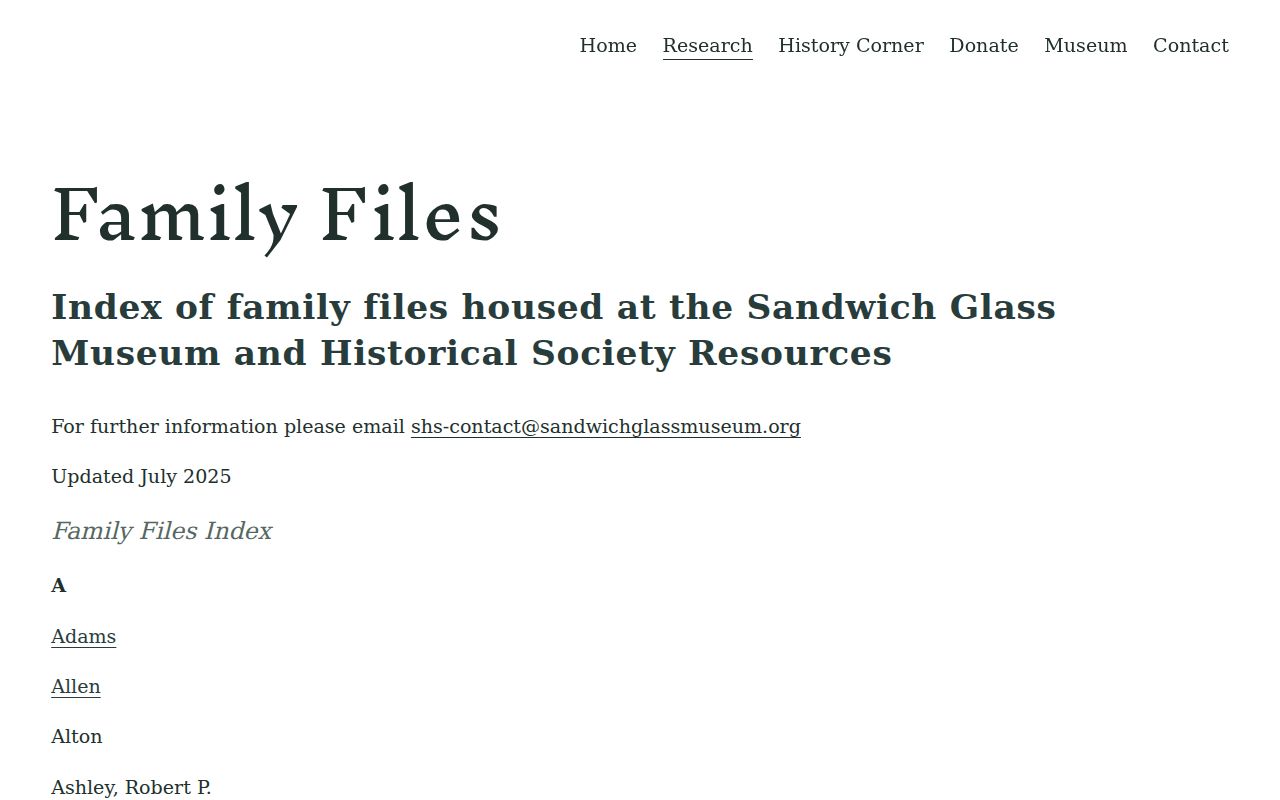
Use a Family Files hit to ask a narrower research question, then corroborate it with a dated city directory entry and an independent source.
Digital Commonwealth senior class photos cover 1940 through 1974, while Sandwich High School and Henry T. Wing yearbooks begin in 1964 in the Archives collection. These are helpful companion sources for a school-era lead, but neither replaces a volume citation or resolves a same-name person on its own.
Tracing Sandwich Directory Households
A careful household trail moves from one dated entry to the next without filling unknown years by guesswork. Start with the strongest spelling and place clue, then test changes against a federal census image or index released by the National Archives. Census access follows a 72-year release rule, and its enumeration geography and spelling should be recorded. The sequence below treats each source as a snapshot, not a continuous record.
- Locate the earliest relevant Sandwich or regional directory volume and capture the full citation before interpreting its listing.
- Search the next available directory year for the same name, initials, address, and associated household clues.
- Pair the dated entries with an available census year, noting the exact enumeration geography and whether the result is an index or image.
- Test a move, disappearance, or new name against a deed, newspaper notice, cemetery lead, or archival family material.
- Keep conflicting results separate until two independent source types support the same identity.
A person who vanishes from a city directory may have moved, died, changed name spelling, gone unlisted, or simply fallen in a gap between known volumes. The Sandwich resident lookup route is better suited to a modern record question after the historical timeline has supplied a name or address lead.
Sandwich Directory Newspaper Pairing
The Sandwich digital newspaper archive holds local titles from 1846 forward. Its search controls are dynamic, so recheck the live query options. Search a surname with a village, business, organization, or year window, then inspect nearby pages because OCR can miss a name. Capture the title, issue date, page, image URL, and the surrounding wording rather than relying on a search snippet.
Newspapers can help explain a directory change through a move notice, business notice, school item, town meeting report, or obituary. They still need a namesake audit. A newspaper mention of a person or place is historical context, not proof of a current address.
Note: Adjacent newspaper pages may preserve a name that the archive's OCR did not return in a direct search.
Sandwich Map Business Directory
The Historical Commission's historic maps include the 1858 Walling map of Sandwich Village with an accompanying business directory. That pairing makes a strong place-based research lead. Preserve the map year, street or locality wording, and business-directory wording as printed, then test a name in newspapers, deeds, and later volumes. It does not create a modern street-address match.
Route 6A and Old King's Highway are recurring historic labels. No verified universal former-address or renumbering crosswalk was located, so retain the historic label separately from a current parcel reference instead of forcing them to match.
Sandwich Directory Research Timeline
The dates below are research anchors, not a claim of an uninterrupted publication run. They show why a directory result should be placed among other local sources with their own coverage and access limits.
- 1742: Barnstable County land records begin, providing a long ownership trail for a historical address.
- 1846: The earliest listed local digitized newspaper run begins.
- 1858: The Walling Sandwich Village map includes a business directory.
- 1900, 1908, 1926: State Library holdings explicitly list Sandwich directories.
- 1903, 1908, 1926, 1929: NARA regional holdings include Sandwich.
The timeline supports a multi-source approach. A long deed trail may identify ownership, city directories may offer a dated household or business lead, and newspapers or census records may provide context. Keep each conclusion tied to the document that actually supports it.