
Sandwich Resident Lookup Records
Use the record that matches the question. A Sandwich resident lookup is strongest when it identifies the type of connection first, then preserves the record date and custodian. Property records point to an owner or tax-mail recipient, court dockets to a case participant, and historical material to a dated appearance. None creates a complete personal profile.
| Record | What it confirms | Where | Access |
|---|---|---|---|
| Assessment or parcel card | Owner of record, situs, mailing clue, values | Sandwich MapGeo | Public map and card route |
| Recorded deed | Grantor, grantee, and title chronology | Barnstable Registry | Free research index and images |
| Voter status | Registration or pre-registration, active or inactive status, polling information | Massachusetts voter status | Individual self-status, not a town roster |
| Court docket | Party, docket, events, and disposition | MassCourts | Remote access is rule-limited |
| Vital record route | Event facts and relationships, subject to restrictions | Town Clerk, RVRS, or Archives by year | Eligibility and copy rules vary |
| Business, DBA, or license | Public entity or credential connection | State, Town Clerk, and board records | Not proof of residence |
| Newspaper, obituary, or yearbook | Historical school, community, death, or place context | Library and local collections | Dated corroborating source |
Choose the address route for ownership questions, the voter tool only for its stated status result, and an archive for a historical connection. A mailing, business, or former address should never be relabeled as a current home address.
Match Names in Sandwich Records
Make a candidate list before treating two references as one person. Keep the exact spelling, middle initial, suffix, former or married name, approximate date, village, address type, and source date with every result. A person can appear under an initial in a deed, a full name in a docket, and a different surname in an older obituary.
Corroborate with two independent source types. A parcel card plus a recorded instrument, or a newspaper notice plus a vital index, is more reliable than two copies of the same database. Do not merge a deed owner, court party, voter-status result, licensee, or archive subject merely because the names resemble each other. Retain conflicting citations and the uncertainty.
Verify a Sandwich Resident Lookup
For a current public-record question, begin with an address rather than a broad name search. This order keeps the first result from becoming an unsupported identity match.
- Locate the parcel in MapGeo and record the owner name, situs, parcel identifier, visible mailing clue, and retrieval date.
- Search the Registry by that owner name, not only by address. Its address search is unofficial and incomplete.
- Run an independent index that fits the question, such as voter status, a court docket, a dated newspaper, or a yearbook.
- Compare spelling, date, village, and address type across the two sources. If they disagree, keep the records separate.
The address trail is an ownership lead, not a conclusion about everyone at a parcel. For a whole-address history, use the separate Previous Residents record chain.
MassCourts for Sandwich Names
MassCourts begins with Department, Division, Location, and an optional result count. Its public search tabs are Name, Case Type, Case Number, and Ticket/Citation Number. Location can depend on the selected department and division, so record the court choice before interpreting an empty result.
For the civil Name tab, the last name needs at least two characters and the first name at least one. Middle name, suffix, case type, status, party type, and date fields are optional. Case Type searches use a maximum 30-day date range. A known case number is more precise, but capitalization, spaces, case pattern, and leading zeros must match exactly.
Probate and family matters have a separate Barnstable Probate and Family Court route. Adoption and other protected matters can be impounded or unavailable under statute or court rule.
Sandwich Docket Result Boundaries
A result screen can identify a party, docket number, event, case type, filing date, status, and disposition. It is not the complete court file. Save the department, location, docket exactly as displayed, result URL, retrieval date, and whether a document image is actually available before asking a clerk for a copy.
- Docket
- The court’s chronological case log, not every underlying document.
- Index versus image
- An index lists a record or docket; an image is a viewable document and may be unavailable.
- Certified copy
- A copy issued or authenticated by the responsible custodian for an official purpose.
Sealed, impounded, juvenile, adoption, abuse-prevention, and other protected cases are not ordinary public results. A party hit establishes only the limited case connection shown.
Sandwich Vital Record Routes
The Sandwich Town Clerk lists local certified birth, marriage, and death copies at $10. The local form supports requests, while mail, in-person, and ordering details should be confirmed with the Clerk. A recent event can require different documentation or restrictions than an historical request.
Massachusetts RVRS holds records from 1936 forward. The Massachusetts Archives holds births, marriages, and deaths from 1841 through 1935. There is no supported blanket 90-year or 50-year rule. Restrictions can affect birth records involving unmarried parents, related marriage records, adoption material, and a full SSN on a death record.
Sandwich License and History Clues
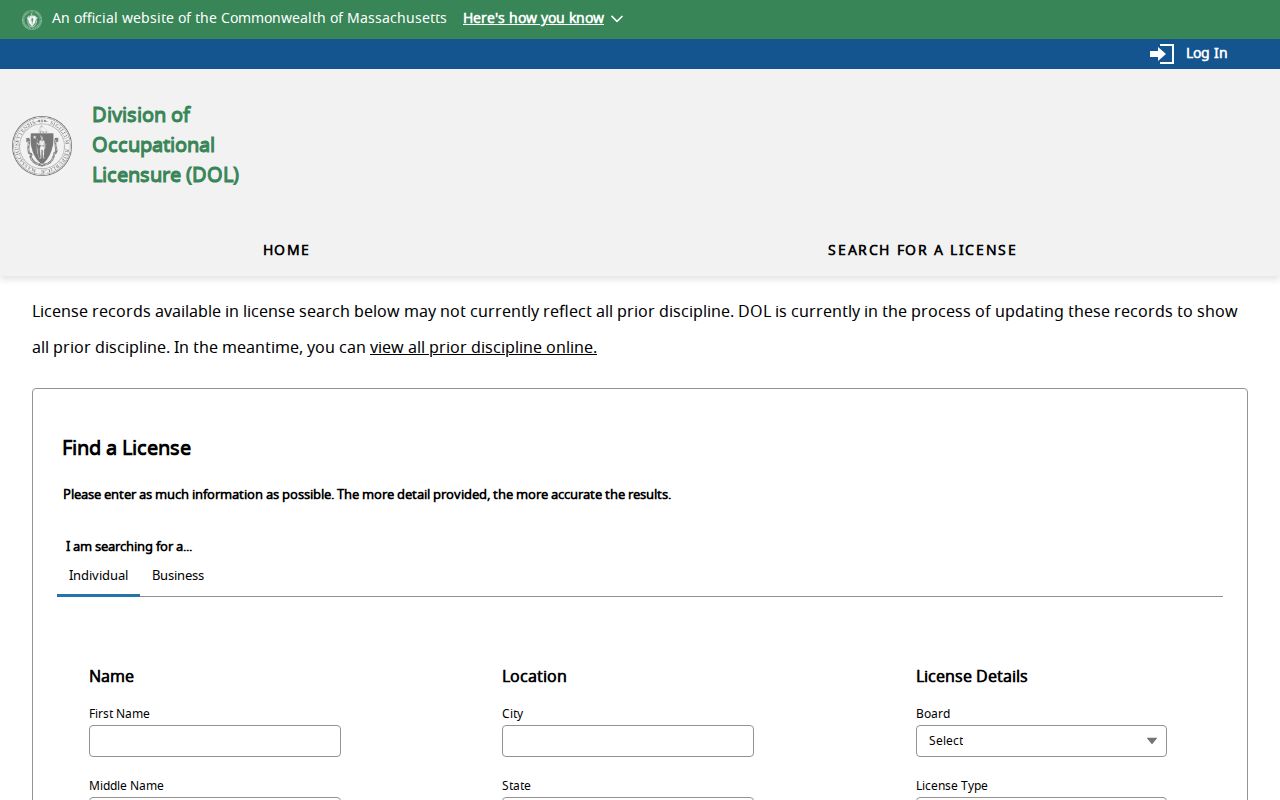
A public credential can corroborate a name or professional status, but not a home address. The Massachusetts occupational license search has Individual and Business tabs, then name, city, state, ZIP, board, license type, and license-number fields. Results may show a number, type, issue or expiration date, status, and board information.
The state occupational-license search displays the available public filters.
Use a public credential beside a property, court, or historical record, not as a residence claim. Entity filings and Sandwich DBA records describe different relationships and need their own dates. For older connections, local newspaper notices, obituaries, yearbooks, and Library Archives provide a dated historical witness.
Sandwich Records Request Fallback
When a portal does not carry the defined record, request the record series rather than a compiled person dossier. Sandwich Records Access Officer Taylor D. White, Town Clerk, accepts requests by email at twhite@sandwichmass.org, by mail, or in person. The Town’s public-records form describes acknowledgment within 24 hours or less and a response target of 10 business days.
Name the request type, date range, custodian, and preferred response. Ask for a dated annual street-list volume or a particular permit record, subject to redaction, rather than asking who lives at an address. M.G.L. c.66 §10 provides a public-record process but does not override a court seal, vital restriction, or privacy law.
Sandwich Court Access in 2026
The Barnstable Superior Courthouse is closed during renovation, with temporary operations expected through a summer 2027 reopening. The county’s construction notice directs visitors to confirm the current location before an in-person visit. A temporary building move does not expand remote access or make a protected file public.
Limits on a Sandwich Resident Lookup
Public does not mean unrestricted. The Massachusetts Address Confidentiality Program, under M.G.L. c.9A and 950 CMR 130.00, protects qualifying substitute addresses. Court rules, vital-record restrictions, and the federal Driver’s Privacy Protection Act can protect other information. Do not copy a protected address, full SSN, signature, account number, or sealed material.
Lawful use. Use a Sandwich resident lookup for personal, lawful research such as family history, estate work, or verifying a record. Do not use records to stalk, harass, intimidate, or harm anyone.
Sandwich Historical Resident Witnesses
When a current index does not answer a historical question, Sandwich has local sources that can establish a dated connection without pretending to show a present address. The Sandwich Public Library Archives holds family files, local newspapers, yearbooks, property asset files, maps, town reports, meeting records, photographs, and census material. An appointment is recommended for its non-circulating local-history resources. The Historical Society’s Family Files Index, updated in July 2025, is another finding aid for local surnames and materials.
Those sources need a citation trail. For a newspaper hit, save the title, issue date, page, image URL, and search spelling. For a directory or yearbook, retain the volume title, year, page, and the exact wording. A family file, photograph caption, or obituary can be a valuable lead, but it does not establish that two same-name people are one person. Pair it with an independent source such as a vital record, census image, deed, probate filing, or a second dated archive record.
The local newspaper archive lists Sandwich titles from 1846 forward, while the State Library identifies Sandwich directory years of 1900, 1908, and 1926. Those dates create useful checkpoints for a resident lookup. They also show why a result must be tied to its year: a historic village, address, or family relationship may not describe the same person or place today.
Some personal-history questions have an official route with limits. Probate records can lead to estate material, but the responsible Probate and Family Court controls access. Adoption records are not ordinary public files; Massachusetts directs eligible adult adoptees and other authorized people to its specific pre-adoption birth-record process, while others may need a court order. A clerk can explain the custodian and request procedure, but should not be asked to confirm protected details informally. The proper result is a source citation or a lawful next step, not an inference from a missing public search result.